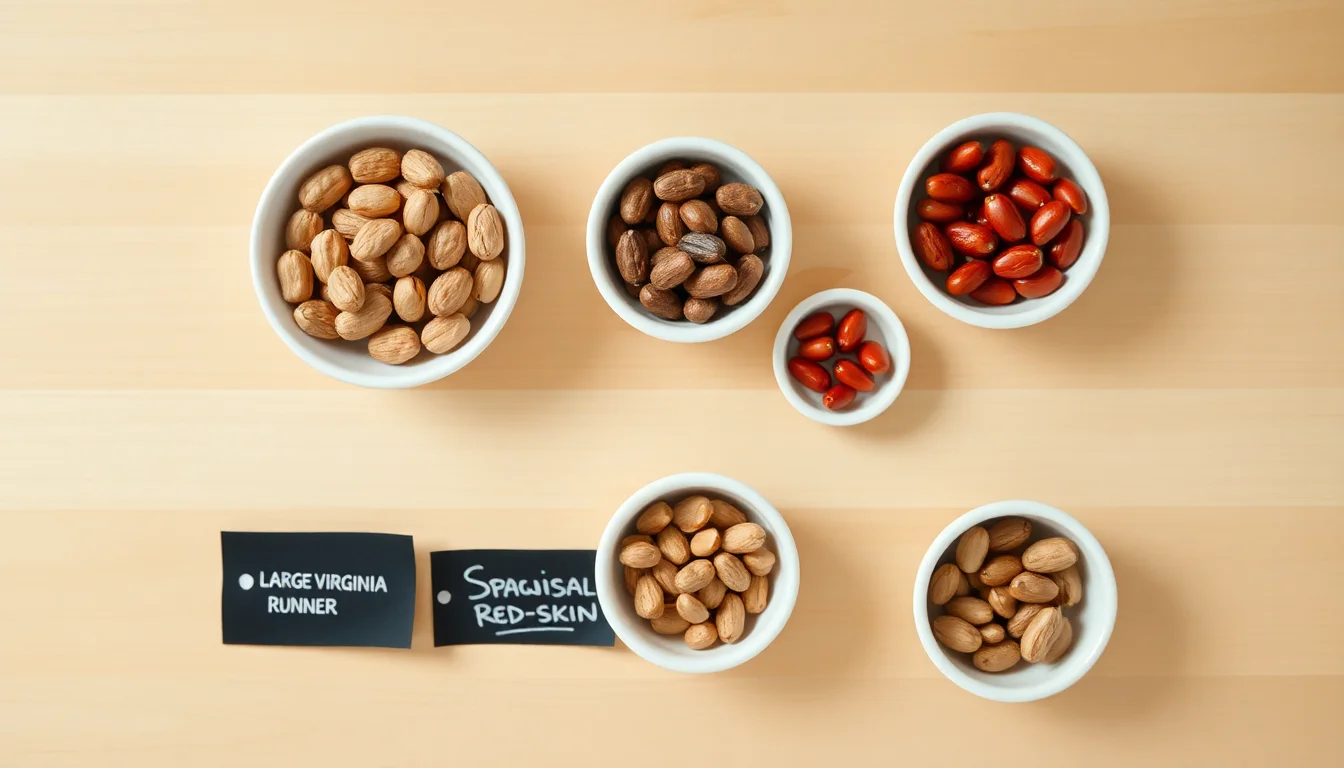

If you’ve ever searched “bulk raw peanuts” and ended up staring at four different variety names wondering whether it matters which one you buy — yes, it matters, and nobody explains why. The short version: peanuts in the United States come in four main market types — Virginia, Runner, Spanish, and Valencia — and they differ in size, flavor, fat content, and what they’re genuinely best at. Buy the wrong one for boiling and you’ll end up with mushy shells. Buy the wrong one for brittle and your candy will taste flat. I made both mistakes before I understood what I was actually ordering. This article gives you a side-by-side breakdown of all four, shows you the price spread you should expect in mid-2026, and ends with a straight “if X, buy Y” decision rule so you can stop second-guessing.
The Four Types at a Glance
Let me give you the table first, then the explanation.
| Type | Typical kernel size | Flavor profile | Fat content (approx.) | Primary growing region | Most common use |
|---|---|---|---|---|---|
| Virginia | Large to extra-large | Mild, clean, slightly sweet | ~48–50% | Virginia, NC, South Carolina | Gourmet snacking, in-shell roasting, cocktail peanuts |
| Runner | Medium, very uniform | Neutral, consistent | ~47–49% | Georgia, Alabama, Florida, TX | Commercial peanut butter, trail mix, candies |
| Spanish | Small, round | Bold, nutty, slightly earthy | ~50–52% | Oklahoma, Texas | Peanut brittle, peanut oil, ballpark-style snacking |
| Valencia | Small to medium, 3+ kernels per pod | Sweet, distinctly rich | ~45–47% | New Mexico (primarily) | Fresh eating, home peanut butter, boiling in-shell |
Sources: National Peanut Board type descriptions; American Peanut Council type reference.
By the numbers (mid-2026 bulk retail pricing, 25-lb bags):
- Runner (blanched, #1): ~$52–$68
- Spanish (redskin, raw): ~$58–$74
- Virginia (in-shell, extra-large): ~$72–$95
- Valencia (in-shell, raw): ~$80–$110 (limited availability; mostly direct-farm or specialty)
These ranges reflect what I’m seeing across Hampton Farms, Aldridge Peanuts, and major Amazon fulfillment listings as of spring 2026. Valencia at the high end is partly a scarcity premium — New Mexico production is a fraction of Georgia Runner volume.
Virginia Peanuts: The Showpiece Variety
Virginia-types are the big ones. When you crack open a gourmet tin of cocktail peanuts or see “extra-large” on a roadside stand in the Carolinas, you’re almost certainly looking at Virginias. The kernels are elongated rather than round, and the shells are distinctly ridged.
Why size matters here: Virginia peanuts are graded partly by kernel count per pound. “Extra-large” Virginias run roughly 45–65 kernels per pound; regular Virginia runs 65–80. Runner peanuts, for comparison, run 810–1,020 kernels per pound at the commercial grade — they’re just a different animal. The Virginia Carolinas Peanuts association notes that the Virginia-type growing region extends through the Tidewater area of Virginia down into northeastern North Carolina and parts of South Carolina.
Best uses: In-shell roasting, in-shell boiling (the large shell gives great texture), gourmet gift tins, cocktail peanuts, wedding snack bars. If someone is doing an in-shell peanut bar at a Southern wedding or rehearsal dinner, I’d push them toward Virginias almost every time — the presentation is just better, and the mild flavor doesn’t overpower.
Where Virginias struggle: Commercial peanut butter. The size variation makes them harder to process uniformly, which is why the industry largely switched to Runners in the 1970s (more on that below). For brittle, the large pieces can create structural issues in thin-pull candy unless you roughly chop them first.
Pricing note: You’ll pay a premium. Virginia in-shell from Whitley’s or Virginia Diner runs $1.80–$2.20/lb at retail in 5-lb bags. At 25-lb bulk, you can get closer to $1.50–$1.75/lb if you’re buying direct from a regional shipper. That’s legitimately 30–50% more than Runner for the same weight — make sure the presentation value justifies it for your use case.
Runner Peanuts: The Workhorse
If you’ve eaten peanut butter in the last 40 years in the United States, you’ve eaten Runner peanuts. According to USDA production data, Runners account for roughly 80% of total U.S. peanut production. They took over commercial peanut butter manufacturing from Spanish types starting in the late 1970s because their kernel size is exceptionally uniform — that uniformity means roasting is consistent across a batch, which matters enormously when you’re running industrial roasters.
Flavor profile: Clean, neutral, consistent. Runners are not exciting, and that’s not an insult — it’s the point. A neutral peanut lets added salt, sweeteners, or roast level do the flavor work without the peanut itself pushing back. That’s exactly what you want in commercial PB, trail mix, peanut candies, and granola.
Best uses: Homemade peanut butter (if you want a neutral base), granola and energy bars, candy coatings, trail mix, any recipe where the peanut is supporting another flavor rather than starring. For a PTA fundraiser selling pre-bagged roasted peanuts, Runners are probably your right answer — widely available, lowest cost per pound, crowd-pleasing.
Where Runners struggle: They’re too mild for brittle (where you want the peanut to be the star), and they’re visually undistinguished in an in-shell snacking application. Acceptable for boiling but not my first choice.
Buying tip: Hampton Farms is one of the largest Runner processors in the country and ships direct. Their 25-lb raw blanched Runner (no skin) is the standard benchmark price I use to evaluate everyone else. If a supplier is more than 15% above Hampton Farms’ current posted price for comparable grade, they need to justify it.
Spanish Peanuts: The Brittle Maker’s Peanut
Spanish peanuts are small, round, covered in a reddish-brown skin (that’s what “redskin” means on labels — it’s not a separate variety, just Spanish with the skin on), and they have the highest oil content of the four types. That fat level is what makes them ideal for peanut brittle: more oil means more flavor extraction during the cooking process, and the small kernel size distributes evenly through a thin brittle pull without creating thick spots.
The University of Georgia Cooperative Extension’s peanut production resources note that Spanish-type production is concentrated in Oklahoma and Texas — it never moved as heavily to Georgia as Runners did, partly because its agronomics suit the drier western growing belt better.
Best uses: Peanut brittle (this is the canonical brittle peanut — don’t substitute without understanding what you’re giving up), ballpark-style snacks, peanut oil production, any application where high-fat, intense peanut flavor is the goal.
Where Spanish struggle: Peanut butter made entirely from Spanish will taste “heavier” and more oily to most people — fine for some home peanut butter makers who want intensity, but not what most people are expecting. Too small and delicate for in-shell snacking applications.
Pricing note: Spanish redskin in 25-lb raw bags runs slightly higher than Runner because production volume is lower. Expect $2.20–$2.80/lb at specialty retail; $1.50–$1.70/lb at true bulk (50-lb+ from Aldridge or similar regional suppliers). If you’re making brittle in any serious volume, the flavor payoff justifies the premium over Runners.
Valencia Peanuts: The Sweet One
Valencia is the outlier. While the other three types typically have two kernels per shell, Valencias regularly have three or four smaller kernels packed into a longer pod. The flavor is noticeably sweeter — there’s less of the “raw peanut” earthiness that some people find aggressive — which makes them popular for fresh eating straight from the pod and for home peanut butter where you want something that tastes like it doesn’t need added sugar.
Nearly all U.S. Valencia production comes from New Mexico, primarily around Portales. This geographic concentration means supply is limited and seasonal in a way the other types aren’t. If you’re sourcing Valencias for an August event, you may hit a window where last year’s crop is sold out and new-crop isn’t shipped yet.
Best uses: Home peanut butter (sweet flavor, no additives needed), boiled peanuts if you can find green Valencias (though Virginia in-shell is more commonly available for boiling in the Southeast), fresh-eating from the shell, children’s snacking.
Where Valencias struggle: They’re hard to find in bulk at reasonable prices outside of specialty channels. They’re not well-suited for commercial candy applications because the three-to-four-kernel pods create inconsistent piece sizes. For most practitioner-level buyers, Valencia is a niche pick — right for specific applications, wrong as a general-purpose workhorse.
The Decision Rule
Here’s the “if X, then Y” I promised:
- In-shell snack bar, wedding, or party presentation → Virginia in-shell. Pay the premium; the size sells itself.
- Homemade peanut butter, granola, trail mix, fundraiser snack bags → Runner blanched or redskin. Lowest cost, most available, consistent.
- Peanut brittle, any candy where peanut flavor is the hero → Spanish redskin, raw. Don’t substitute.
- Sweet home peanut butter, fresh eating, small-batch boiling → Valencia, if you can source it and the price works. Otherwise Virginia in-shell for boiling.
- Boiling at volume (event or food-service scale) → Virginia in-shell, or ask your regional supplier about Runner in-shell if Virginias are out of stock — just know the texture will be slightly different.
- You’re not sure yet → Start with Runner. It’s the most forgiving, the most available, and the cheapest way to test a recipe or process before you commit to a specialty variety.
The one thing I’d caution against is treating “peanut” as a generic commodity input on your first few orders. The variety you buy is a real production variable — especially in brittle and peanut butter, where I’ve seen batches go wrong simply because someone subbed Runner for Spanish and didn’t adjust roast time or expect the flavor difference. Source intentionally, even on small orders, and you’ll save yourself the batch you have to throw out.